
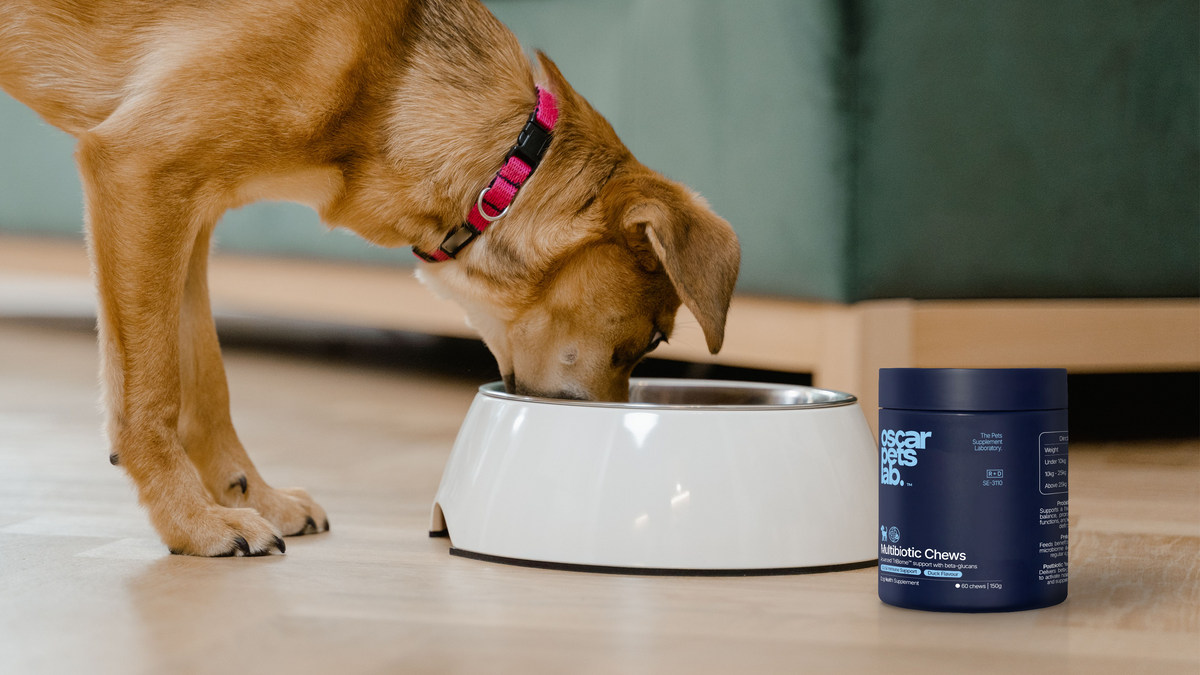
Your dog is four, five, or six years old. They still greet you at the door, still follow you into the kitchen, and still know exactly where the treat jar lives. But lately something feels different. Walks are a little slower. Breakfast gets a softer tail wag than it used to.
It is natural to wonder whether they are simply getting older. Age does change a dog's routine, energy, and nutritional needs over time. Changes like these are nonspecific: they can reflect age, pain, dental discomfort, illness, stress, diet, or many other causes. On their own they do not identify a gut problem.
The goal is not to guess what is happening from the outside. Changes in appetite, energy, stool, skin, or behaviour are worth noticing and worth discussing with your veterinarian when they persist. Understanding what the gut does can still help you recognise which digestive changes are worth tracking.
What the Gut Actually Does in Dogs
The canine gut is not just a tube that moves food from bowl to backyard. It is home to trillions of microorganisms, including bacteria, fungi, and other communities that live along the gastrointestinal tract. This ecosystem is often called the gut microbiome.
In dogs, the microbiome is studied in relation to how nutrients are broken down, how short-chain fatty acids are produced, how the immune system receives signals, and how the body maintains normal digestive rhythm. A review described the intestinal microbiota of dogs and cats as far more complex than earlier culture-based methods suggested. [1] A later canine review examines how the gut microbiome and metabolome relate to health and gastrointestinal disease. [2]
There is also interest in the gut and behaviour. One study compared 11 dogs with aggressive behaviour and 13 with phobic behaviour against 18 dogs with normal behaviour. The aggressive group had a distinct gut community, richer in Catenibacterium and Megamonas, and the phobic group had more Lactobacillus, while stress-hormone levels did not differ between groups. [3] It was a single snapshot, so it shows an association; it does not show that changing the microbiome changes behaviour or energy.
When “Slowing Down” Might Actually Be Gut-Related
Some everyday changes overlap with normal ageing, stress, food changes, and digestive upset. Stool consistency, appetite, vomiting, abdominal discomfort, and gas are the observations most directly related to the digestive tract. Lower energy, a dull coat, or dry skin are nonspecific, have many possible causes, and are not a test of gut health.
When researchers compare dogs with a diagnosed gut condition against healthy dogs, the differences are real but specific. Dogs with inflammatory bowel disease had less diverse gut bacteria and a different community, and those differences remained even after treatment improved their signs. [4] Dogs with acute diarrhoea had less diversity, less Faecalibacterium and lower faecal propionate, a short-chain fatty acid made by gut bacteria. [5] These are studies of unwell dogs: they explain why stool and appetite are worth watching, not how to diagnose a gut problem from mild changes at home.
Food enthusiasm can shift for many reasons: routine, temperature, stress, dental comfort, food preference, or digestive discomfort. One observation rarely explains the whole picture, but repeated patterns deserve attention and are worth raising with your veterinarian.
What Research Suggests About Gut Health in Aging Dogs
Dogs do not all share one identical "healthy" microbiome. In 96 healthy dogs, gut bacteria differed by breed, and one species, Fusobacterium perfoetens, was about twice as abundant in dogs aged 6–10 years as in dogs under a year (14.3% against 7.2%). [6] Normal variation like this is one reason a routine should be built around the individual dog rather than a trend.
Defined probiotic strains have been tested in healthy dogs. When 15 healthy adult dogs ate food containing Lactobacillus acidophilus DSM13241 for four weeks, the strain was found in their faeces, faecal lactobacilli rose and clostridia fell, and some blood immune measures (neutrophils, monocytes and IgG) increased. Two weeks after feeding stopped, the strain was no longer detected. [7] The study had no separate control group and measured markers rather than illness, and its results belong to that strain, not to probiotics as a class.
A 2025 placebo-controlled trial of Bacillus coagulans GBI-30, 6086 in 12 healthy adult dogs found slightly firmer stools overall (an average stool score of about 2.8 against 3.2 on placebo, on a 1–5 scale where lower is firmer) and more faecal Faecalibacterium at the lower dose. Nutrient digestibility, faecal metabolites, immune markers and blood values did not change. [8] The authors concluded that the strain can be safely supplemented and that the lower dose may help maintain stool consistency: a modest finding in healthy dogs, not a treatment effect.
Prebiotics are another part of the picture. The ISAPP consensus statement defines prebiotics as substrates selectively used by host microorganisms that confer a health benefit. [9] That is a definition of the category, not evidence that a particular product delivers a benefit.
What You Can Actually Do
Start with consistency. Dogs often do best when meals happen at predictable times, water is easy to access, and diet changes are made gradually. Sudden food swaps can be hard on the digestive routine, even when the new food is high quality. If you are changing diets, move slowly and observe stool, appetite, and comfort along the way.
If you are considering a probiotic or prebiotic, treat it as one part of a routine rather than a fix. Effects depend on the specific strain, the dose, and the situation, and not every digestive change responds to supplementation. Your veterinarian is the right person to help decide whether a supplement is appropriate for your dog.
Finally, keep a simple log if your dog seems different. Note stool quality, appetite, energy, gas, and any new foods or stressors. Patterns are more useful than one-off moments, and a short record can make a veterinary conversation much clearer.
When to See Your Vet
Gut health can be supported at home, but some signs need professional attention. Use the signs below as a guide rather than a fixed timetable, and trust your sense of what is normal for your dog.
Puppies, older dogs, and dogs with existing medical conditions may need assessment sooner. Mild diarrhoea in an otherwise bright dog may resolve on its own, but veterinary advice is appropriate if it persists or if any of these signs appear. This list is a guide, not a complete account of every reason to call your vet.
- Your dog stops eating
- Unusual lethargy or weakness
- Repeated vomiting
- Black, tarry, or bloody stool
- Abdominal pain or a swollen, painful belly
- Signs of dehydration
- Symptoms that are worsening, or diarrhoea that persists
Daily routines can support a healthy foundation, but they are not a substitute for veterinary care when warning signs appear. Your dog's baseline matters, and your veterinarian is the right partner for interpreting meaningful changes.


